I am a Ph.D. candidate in Computer Science at the University of Maryland, College Park, advised by Prof. Pratap Tokekar and Prof. Ming Lin. I have interned at Netflix Research, Tencent Hunyuan LLM Frontier & AI Lab, Apple, and Tencent Robotics X, and I received my bachelor’s degree from Shanghai Jiao Tong University.
My research focuses on post-training large language models: reinforcement learning, reward modeling, and agentic LLMs that can recursively improve themselves. My work aims to make RL for LLMs stable and sample-efficient, rewards harder to game, and reasoning robust to noisy or degraded inputs.
Research
RL for LLM post-training
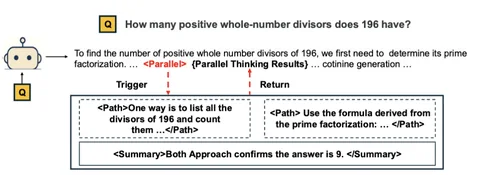
Stable, efficient reinforcement learning with verifiable rewards for (multimodal) reasoning: group-free single-rollout optimization, uncertainty- and curiosity-driven exploration, parallel thinking, and robustness to degraded inputs.
Generative reward models that plan and verify with self-generated rubrics, multimodal judges, process supervision that locates the first error, and self-rewarding vision-language models.
Earlier work: robust and multimodal learning for multi-agent systems and robotics, including
CAML (NeurIPS 2025),
MMCD (IROS 2025),
IMRL (ICRA 2025),
LAVA (IROS 2024, ICRA workshop best paper), and
D3ROC (IROS 2023).
News
Two papers accepted to NeurIPS 2026: ROMA (RL for robust multimodal reasoning) and LLMs Improving LLMs (agentic discovery of test-time scaling strategies).
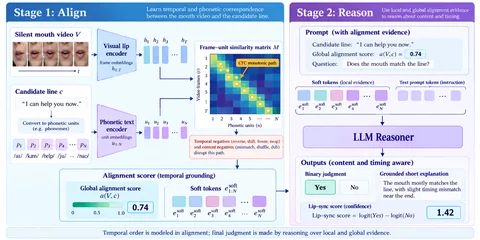
Three new papers: Dream-RSI on recursive self-improvement, CARE on certified VLA inference acceleration, and ATR, a multimodal lip-sync judge.
Research internship at Netflix Research on LLM post-training, reasoning, and reward modeling.
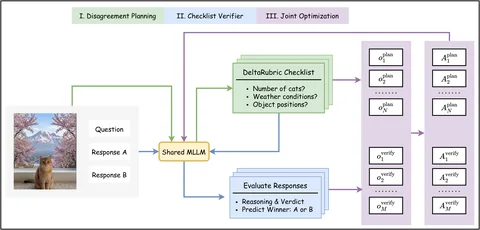
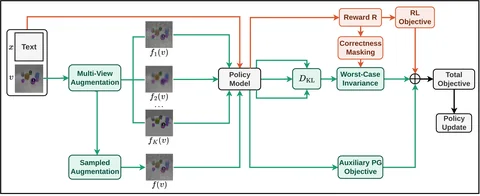
Three new papers: DeltaRubric on multimodal reward modeling with self-generated rubrics, ROMA on robust multimodal reasoning, and AutoTTS on automated test-time scaling.
Parallel-Probe accepted to ICML 2026, and VPPO accepted to ACL 2026 Findings.
Show earlier newsHide earlier news
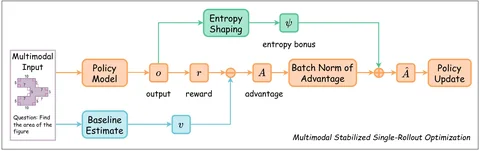
MSSR (Multimodal Stabilized Single-Rollout RL) accepted to CVPR 2026.
Three new papers: A2MAML for multi-agent multimodal learning, Parallel-Probe for efficient parallel thinking, and VPPO for process-supervised RL.
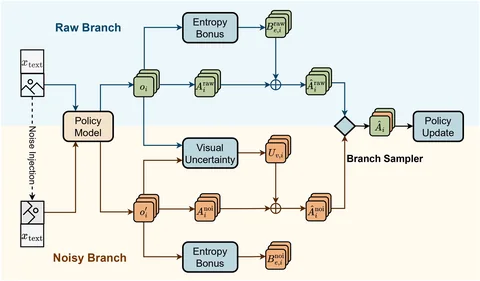
DUPL (Dual-Uncertainty Guided Policy Learning) for multimodal LLM reasoning is out.
MSSR (Multimodal Stabilized Single-Rollout RL) for multimodal LLM reasoning is out.
Three papers on (multimodal) LLM reasoning: Vision-SR1 for VLM reasoning, Parallel-R1 for parallel thinking with RL, and CDE (Curiosity-Driven Exploration) for LLM reasoning.
CAML (multimodal multi-agent learning) accepted to NeurIPS 2025. AdaConG on learning under uncertainty is out.
We propose DeltaRubric, a novel approach that reframes multimodal evaluation as an active, two-step visual investigation through a single shared MLLM, leveraging self-generated rubrics as guidance.
A method that guides policy learning using measured dual-uncertainty (output and perceptual) as feedback signals to encourage exploration and enhance reasoning in multimodal LLMs.
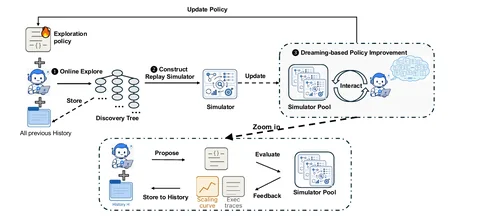
Dream-RSI turns an agent's completed discovery trees into a replay simulator, so new exploration policies can be evaluated and refined offline (by dreaming) before being redeployed online, closing a self-improvement loop at the exploration layer.
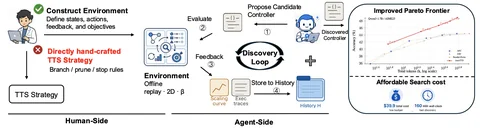
We propose an environment-driven framework, AutoTTS, that changes what researchers design: from individual TTS heuristics to environments where TTS strategies can be discovered automatically.
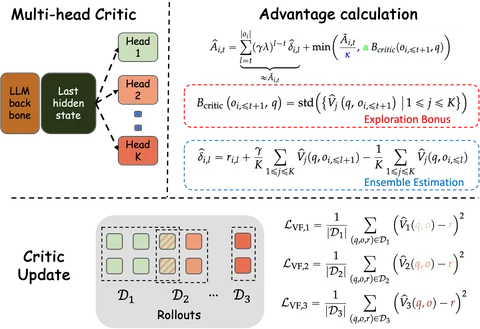
CDE enhances Reinforcement Learning with Verifiable Rewards (RLVR) by using intrinsic curiosity signals from the actor and critic to improve exploration and reduce premature convergence in LLMs.